Thanksgiving at high altitude
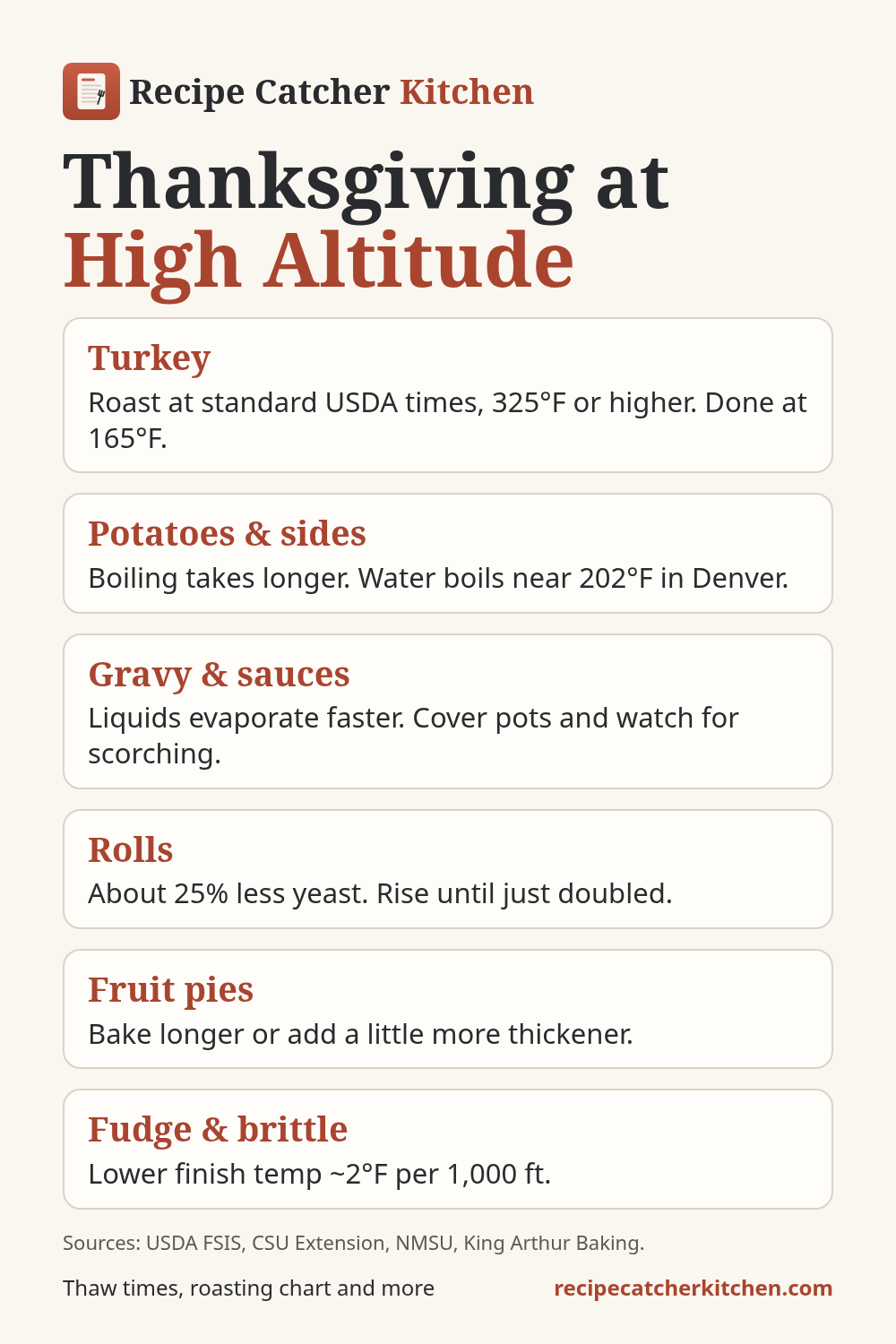
Good news first: the turkey roasts the same as it would at sea level. The oven doesn't care about altitude. What changes is everything that boils, simmers, rises or bakes, plus how fast food dries out on the table.
The short version
- Turkey: use the standard USDA times at 325°F or higher, and cook to 165°F in the thigh, wing and thickest part of the breast.
- Potatoes, vegetables and anything boiled: allow extra time. Water boils at about 202°F in Denver.
- Gravy and sauces: reduce faster in dry air. Cover pots to hold in moisture (USDA).
- Rolls: about 25% less yeast. Watch the dough, not the clock.
- Pie: the crust barely changes. Fruit fillings need longer to thicken.
- Cakes and quick breads: use the altitude adjuster.
Thawing: start earlier than you think
USDA's guidance for thawing in the refrigerator is about 24 hours for every 4 to 5 pounds. For Thanksgiving on Thursday, a 20-pound turkey should go into the fridge by Saturday or Sunday.
| Turkey weight | In the refrigerator | In cold water (change it every 30 minutes) |
|---|---|---|
| 4 to 12 lb | 1 to 3 days | 2 to 6 hours |
| 12 to 16 lb | 3 to 4 days | 6 to 8 hours |
| 16 to 20 lb | 4 to 5 days | 8 to 10 hours |
| 20 to 24 lb | 5 to 6 days | 10 to 12 hours |
Source: USDA FSIS, Let's Talk Turkey. Cook a cold-water-thawed turkey right away.
Roasting the turkey
USDA says to use sea-level times and temperatures when oven-roasting meat and poultry, because oven temperatures aren't affected by altitude. Set the oven no lower than 325°F, and use a thermometer rather than the clock or the pop-up timer.
| Weight (325°F oven) | Unstuffed | Stuffed |
|---|---|---|
| 4 to 8 lb (breast) | 1 1/2 to 3 1/4 hours | 6 to 8 lb breast: 2 1/2 to 3 1/2 hours |
| 8 to 12 lb | 2 3/4 to 3 hours | 3 to 3 1/2 hours |
| 12 to 14 lb | 3 to 3 3/4 hours | 3 1/2 to 4 hours |
| 14 to 18 lb | 3 3/4 to 4 1/4 hours | 4 to 4 1/4 hours |
| 18 to 20 lb | 4 1/4 to 4 1/2 hours | 4 1/4 to 4 3/4 hours |
| 20 to 24 lb | 4 1/2 to 5 hours | 4 3/4 to 5 1/4 hours |
Times are approximate (USDA). A turkey cooked from frozen takes at least 50% longer. Let it rest 20 minutes before carving.
Stuffing is safest baked in a separate dish. Inside the bird or out, it has to reach 165°F (USDA). Frying a turkey? USDA's general frying advice at altitude is to lower the oil temperature about 3°F per 1,000 feet. In Denver that's about 15 to 16°F lower than a sea-level recipe says.
Potatoes, vegetables, gravy and other things on the stove
Water boils at a lower temperature up here: about 202°F at 5,280 feet and 198°F at 7,500 feet. Anything boiled or simmered cooks cooler, so it takes longer: potatoes, green beans, stock, cranberry sauce (CSU Extension). Turning up the heat won't speed it up. It only boils the water off faster (USDA).
Liquids also evaporate faster in high, dry air, so gravy and sauces thicken sooner and can scorch. USDA suggests covering food while it cooks to hold in moisture. If you're using a slow cooker for a side, choose a setting that keeps food at 200°F or higher, and start it on high for the first hour.
Our boiling point by elevation table has the number for your town.
Rolls and bread
Dough rises faster at altitude. Start with about 25% less yeast (King Arthur), and let it rise only until it has doubled, because over-proofed dough bakes up heavy or collapses (CSU). A slow first rise in the refrigerator also works, and it frees up counter space on a busy day.
Pies
Pie crust is low in moisture, so it needs little or no adjustment, though it may take a bit more water to come together in dry air. Fruit fillings come to a boil at a lower temperature, so they take longer to thicken. Bake them longer, or add a little more thickener (King Arthur).
Cakes, quick breads and cookies
Pumpkin bread, cornbread and cake need the usual high-altitude changes: a slightly hotter oven, less leavening and sugar, and a bit more liquid and flour. Plug your recipe into the adjuster or keep the printable chart on the fridge.
Fudge, brittle and candied pecans
Sugar syrups need a lower finish temperature. Lower it by the number of degrees your water boils below 212°F, which is roughly 2°F less for every 1,000 feet. At 5,000 feet, a 238°F fudge finishes at about 228°F (NMSU; CSU).
On the table and after
Food dries out faster at altitude when it sits out (USDA). Bring dishes out in smaller batches. Refrigerate leftovers within 2 hours, and use them within 3 to 4 days. Reheat to 165°F (USDA).
Sources
- USDA FSIS, Let's Talk Turkey: A Consumer Guide to Safely Roasting a Turkey
- USDA FSIS, High Altitude Cooking
- CSU Extension, High Elevation Food Preparation Guide; Baking at Elevation; Candy Making at High Elevation
- New Mexico State University, High-Altitude Cooking
- King Arthur Baking, High-Altitude Baking
General guidance, not a guarantee. Ovens, flours and kitchens vary, so test and adjust one thing at a time.