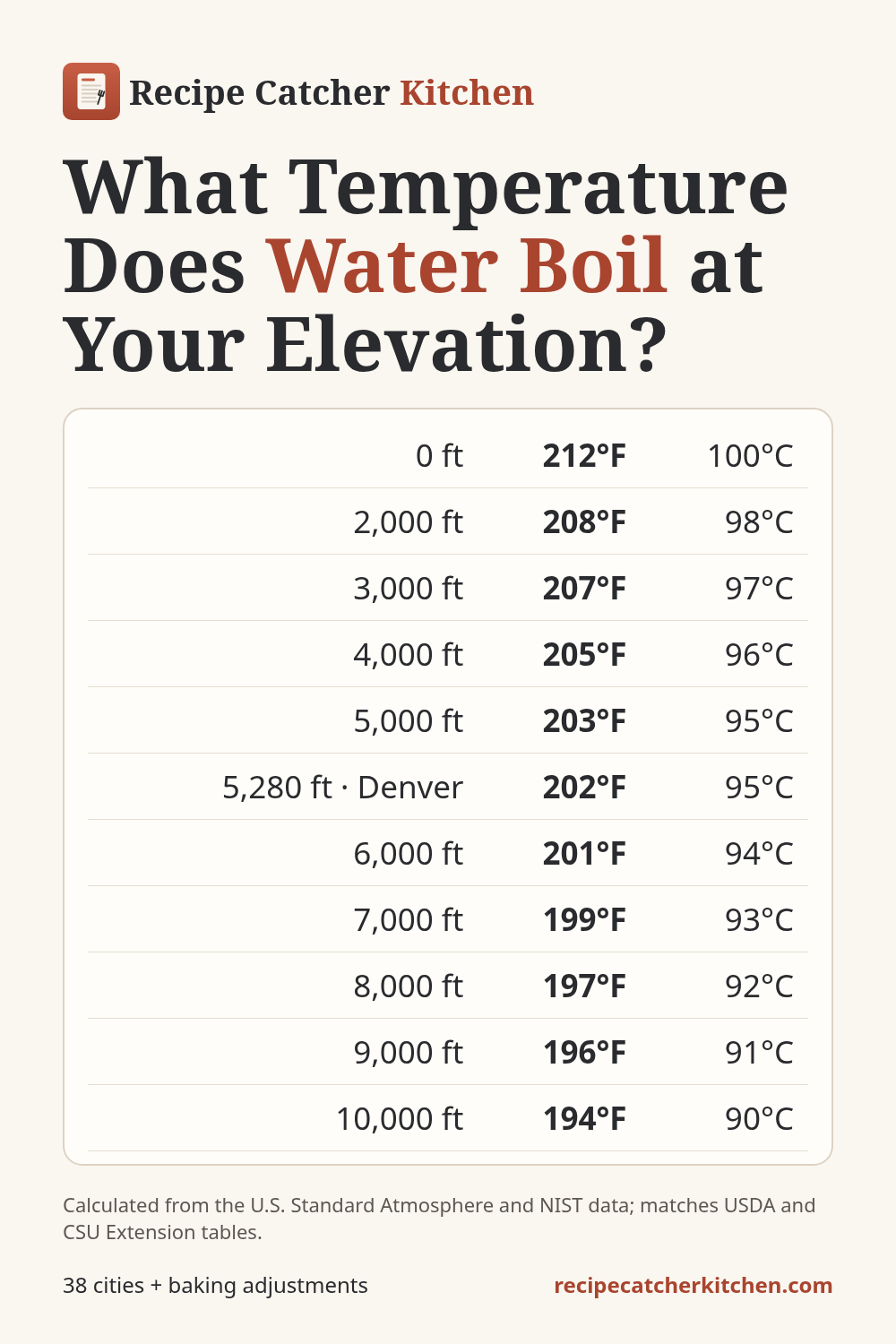
Boiling point of water by elevation
Water boils at 212°F at sea level and about 1°F lower for every 500 feet you climb. In Denver, at 5,280 feet, it boils at about 202°F (95°C). At 10,000 feet it's about 193 to 194°F.
Why it changes
Water boils when its vapor pressure matches the air pressure around it. Air pressure falls as you go up: about 14.7 pounds per square inch at sea level, 12.3 at 5,000 feet, and 10.2 at 10,000 feet (USDA FSIS). Less pressure means water boils at a lower temperature, so anything cooked in boiling or simmering water cooks cooler and takes longer. Turning up the burner doesn't help; it just boils the water away faster.
Weather shifts these numbers slightly from day to day (NMSU), which is why candy makers check their thermometer in boiling water on the day they cook.
Boiling point by elevation
| Elevation (ft) | Elevation (m) | Boiling point (°F) | Boiling point (°C) | Air pressure (psi) |
|---|---|---|---|---|
| 0 | 0 | 212.0°F | 100.0°C | 14.7 |
| 500 | 152 | 211.1°F | 99.5°C | 14.4 |
| 1,000 | 305 | 210.2°F | 99.0°C | 14.2 |
| 1,500 | 457 | 209.3°F | 98.5°C | 13.9 |
| 2,000 | 610 | 208.4°F | 98.0°C | 13.7 |
| 2,500 | 762 | 207.4°F | 97.5°C | 13.4 |
| 3,000 | 914 | 206.5°F | 97.0°C | 13.2 |
| 3,500 | 1,067 | 205.6°F | 96.5°C | 12.9 |
| 4,000 | 1,219 | 204.7°F | 95.9°C | 12.7 |
| 4,500 | 1,372 | 203.8°F | 95.4°C | 12.5 |
| 5,000 | 1,524 | 202.9°F | 94.9°C | 12.2 |
| 5,500 | 1,676 | 202.0°F | 94.4°C | 12.0 |
| 6,000 | 1,829 | 201.0°F | 93.9°C | 11.8 |
| 6,500 | 1,981 | 200.1°F | 93.4°C | 11.6 |
| 7,000 | 2,134 | 199.2°F | 92.9°C | 11.3 |
| 7,500 | 2,286 | 198.3°F | 92.4°C | 11.1 |
| 8,000 | 2,438 | 197.4°F | 91.9°C | 10.9 |
| 8,500 | 2,591 | 196.5°F | 91.4°C | 10.7 |
| 9,000 | 2,743 | 195.5°F | 90.9°C | 10.5 |
| 9,500 | 2,896 | 194.6°F | 90.3°C | 10.3 |
| 10,000 | 3,048 | 193.7°F | 89.8°C | 10.1 |
Calculated from the U.S. Standard Atmosphere (1976) and NIST's vapor-pressure (Antoine) equation for water. The results agree with published tables: USDA gives 208°F at 2,000 feet and about 198°F at 7,500 feet. CSU Extension gives 203°F at 5,000 feet and 193°F at 10,000 feet.
High-altitude US cities
Elevation, boiling point and King Arthur Baking's starting adjustments for a sea-level cake or cookie recipe. Baking powder and soda show what 1 teaspoon becomes. Liquid and flour are added per recipe. Above 8,000 feet the baking chart doesn't apply, so check CSU Extension's guide.
| City | Elevation (ft) | Water boils at | 1 tsp baking powder or soda becomes | Extra liquid | Extra flour |
|---|---|---|---|---|---|
| Leadville, CO | 10,160 | 193°F (90°C) | Beyond chart | Beyond chart | Beyond chart |
| Breckenridge, CO | 9,730 | 194°F (90°C) | Beyond chart | Beyond chart | Beyond chart |
| Telluride, CO | 8,790 | 196°F (91°C) | Beyond chart | Beyond chart | Beyond chart |
| Vail, CO | 8,180 | 197°F (92°C) | Beyond chart | Beyond chart | Beyond chart |
| Aspen, CO | 7,910 | 198°F (92°C) | 1/4 tsp | +3 1/2 to 4 1/2 tbsp | +3 tbsp |
| Mammoth Lakes, CA | 7,870 | 198°F (92°C) | 1/4 tsp | +3 1/2 to 4 1/2 tbsp | +3 tbsp |
| Estes Park, CO | 7,530 | 198°F (92°C) | 1/4 tsp | +3 1/2 to 4 1/2 tbsp | +3 tbsp |
| Los Alamos, NM | 7,210 | 199°F (93°C) | 1/4 tsp | +3 to 4 tbsp | +3 tbsp |
| Laramie, WY | 7,170 | 199°F (93°C) | 1/4 tsp | +3 to 4 tbsp | +3 tbsp |
| Park City, UT | 7,010 | 199°F (93°C) | 1/4 tsp | +3 to 4 tbsp | +3 tbsp |
| Santa Fe, NM | 7,000 | 199°F (93°C) | 1/4 tsp | +3 to 4 tbsp | +3 tbsp |
| Taos, NM | 6,970 | 199°F (93°C) | 1/4 tsp | +3 to 4 tbsp | +3 tbsp |
| Flagstaff, AZ | 6,900 | 199°F (93°C) | 1/4 tsp | +3 to 4 tbsp | +3 tbsp |
| Steamboat Springs, CO | 6,730 | 200°F (93°C) | 1/4 tsp | +3 to 4 tbsp | +3 tbsp |
| Durango, CO | 6,530 | 200°F (93°C) | 1/4 tsp | +3 to 4 tbsp | +3 tbsp |
| Jackson, WY | 6,240 | 201°F (94°C) | 1/2 tsp | +2 1/2 to 3 1/2 tbsp | +2 tbsp |
| South Lake Tahoe, CA | 6,240 | 201°F (94°C) | 1/2 tsp | +2 1/2 to 3 1/2 tbsp | +2 tbsp |
| Cheyenne, WY | 6,090 | 201°F (94°C) | 1/2 tsp | +2 1/2 to 3 1/2 tbsp | +2 tbsp |
| Colorado Springs, CO | 6,010 | 201°F (94°C) | 1/2 tsp | +2 1/2 to 3 1/2 tbsp | +2 tbsp |
| Golden, CO | 5,670 | 202°F (94°C) | 1/2 tsp | +2 1/2 to 3 1/2 tbsp | +2 tbsp |
| Butte, MT | 5,540 | 202°F (94°C) | 1/2 tsp | +2 1/2 to 3 1/2 tbsp | +2 tbsp |
| Aurora, CO | 5,400 | 202°F (95°C) | 1/2 tsp | +2 to 3 tbsp | +2 tbsp |
| Prescott, AZ | 5,370 | 202°F (95°C) | 1/2 tsp | +2 to 3 tbsp | +2 tbsp |
| Boulder, CO | 5,320 | 202°F (95°C) | 1/2 tsp | +2 to 3 tbsp | +2 tbsp |
| Denver, CO | 5,280 | 202°F (95°C) | 1/2 tsp | +2 to 3 tbsp | +2 tbsp |
| Fort Collins, CO | 5,000 | 203°F (95°C) | 1/2 tsp | +2 to 3 tbsp | +2 tbsp |
| Albuquerque, NM | 4,950 | 203°F (95°C) | 7/8 tsp | +2 to 3 tbsp | +1 tbsp |
| Bozeman, MT | 4,810 | 203°F (95°C) | 7/8 tsp | +2 to 3 tbsp | +1 tbsp |
| Pueblo, CO | 4,680 | 203°F (95°C) | 7/8 tsp | +2 to 3 tbsp | +1 tbsp |
| Grand Junction, CO | 4,590 | 204°F (95°C) | 7/8 tsp | +2 to 3 tbsp | +1 tbsp |
| Provo, UT | 4,550 | 204°F (95°C) | 7/8 tsp | +2 to 3 tbsp | +1 tbsp |
| Reno, NV | 4,500 | 204°F (95°C) | 7/8 tsp | +2 to 3 tbsp | +1 tbsp |
| Ogden, UT | 4,300 | 204°F (96°C) | 7/8 tsp | +1 1/2 to 2 1/2 tbsp | +1 tbsp |
| Salt Lake City, UT | 4,260 | 204°F (96°C) | 7/8 tsp | +1 1/2 to 2 1/2 tbsp | +1 tbsp |
| Helena, MT | 4,050 | 205°F (96°C) | 7/8 tsp | +1 1/2 to 2 1/2 tbsp | +1 tbsp |
| El Paso, TX | 3,710 | 205°F (96°C) | 7/8 tsp | +1 1/2 to 2 1/2 tbsp | +1 tbsp |
| Rapid City, SD | 3,240 | 206°F (97°C) | 7/8 tsp | +1 to 2 tbsp | No change |
| Boise, ID | 2,700 | 207°F (97°C) | 1 tsp (no change) | No change | No change |
Elevation is taken at each city's official U.S. Geological Survey reference point (USGS Geographic Names Information System coordinates, elevation from the USGS 3D Elevation Program via the Elevation Point Query Service, retrieved November 18, 2026), rounded to the nearest 10 feet. Cities spread over hundreds of feet, so your street may differ. Baking columns use King Arthur's leavening chart and its liquid and flour rules, and they're starting points to test. Download the data: CSV, JSON.
What a lower boiling point changes in the kitchen
- Pasta, rice, beans, potatoes, soups and stews take longer, because the water is cooler (CSU Extension).
- Hard-cooked and poached eggs take longer too. USDA's advice: don't turn up the heat, add time (USDA FSIS).
- Candy and frosting need a lower finish temperature. Boil water, read your thermometer, and subtract the difference from 212°F from the recipe's temperature. That works out to about 2°F less for every 1,000 feet. If water boils at 202°F, a 238°F fudge finishes at 228°F (NMSU; CSU). The cold-water test works at any elevation.
- Slow cookers simmer cooler. USDA suggests a setting that holds food at 200°F or higher, starting on high for the first hour.
- Deep frying: lower the oil temperature about 3°F per 1,000 feet (USDA).
- Oven roasting isn't affected. Use sea-level times and temperatures for roasting meat and poultry, and check with a thermometer (USDA).
- Baking is affected, for different reasons. Leavening expands more and moisture evaporates faster. Use the high-altitude adjuster or the printable chart.
Cite or reuse this data
The tables and downloads are free to use under CC BY 4.0 with a link back. Suggested credit: "Boiling point of water by elevation," Recipe Catcher Kitchen, recipecatcherkitchen.com/guides/high-altitude/boiling-point-by-elevation/.
Sources
- USDA Food Safety and Inspection Service, High Altitude Cooking
- Colorado State University Extension, High Elevation Food Preparation Guide and Candy Making at High Elevation
- New Mexico State University, High-Altitude Cooking (Guide E-215)
- NIST Chemistry WebBook, water: Antoine equation parameters
- U.S. Standard Atmosphere, 1976 (NOAA, NASA, USAF)
- USGS Geographic Names Information System and USGS Elevation Point Query Service
- King Arthur Baking, High-Altitude Baking